In this guide
Originally published September 6, 2026. Prices and package references reflect that article’s publication. See current Brandiket pricing for today’s offers.
Most business owners know when a website feels wrong. It takes too long to load, doesn't look like it represents the business anymore, or visitors are landing on it and leaving without getting in touch. But knowing something is off and knowing whether it's actually time to invest in a redesign are two different things.
This guide covers nine clear signs that your website has reached the point where a redesign makes business sense — along with practical guidance on what to prioritize when you do move forward.
1. Your Website Looks Outdated
First impressions happen fast. When someone lands on your website for the first time, they form an opinion within a few seconds — and the visual design plays a significant role in whether they stay or leave.
An outdated website doesn't necessarily mean it was bad when it was built. Design conventions change over time. Sites that looked clean and modern in 2015 or even 2018 can feel dated compared to what competitors and industry leaders are doing today. Large fonts, generous spacing, strong photography, and clean layouts have become the baseline expectation.
If your website looks like it belongs to a different era of the internet, that gap in perception affects how potential customers feel about doing business with you — even if your services are excellent.
Quick test
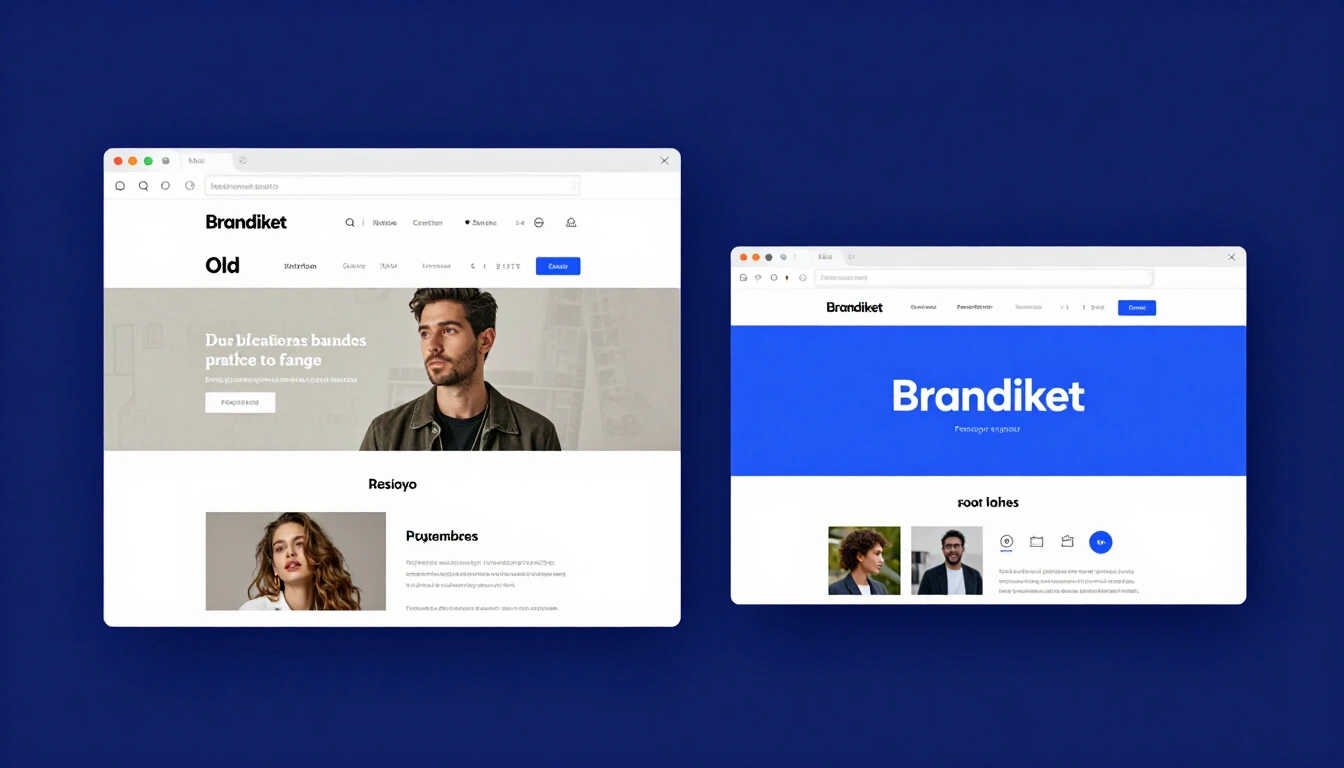
Open your website next to two or three competitors. If yours feels noticeably older or less polished, it's worth taking seriously.2. It Doesn't Work Well on Mobile
The majority of web traffic now comes from mobile devices. For many local service businesses — HVAC, roofing, legal, healthcare — mobile visits often represent more than 60–70% of all traffic. If your website isn't genuinely mobile-friendly, you're losing a significant portion of potential customers before they even get a chance to read what you offer.
"Mobile-friendly" doesn't just mean the text is readable on a phone. It means:
- Navigation works comfortably with a thumb
- Buttons and CTAs are large enough to tap reliably
- Forms are easy to complete on a small screen
- The page loads quickly on mobile connections
- Content isn't cut off or horizontally scrollable
Older websites were often built desktop-first, with mobile as an afterthought. If yours was designed before 2018, there's a good chance it has real mobile usability issues — and those issues are directly costing you leads.
Google also uses mobile performance as a ranking factor, which means a poor mobile experience can affect your organic search visibility in addition to conversion rates.
3. Visitors Can't Quickly Understand What You Do
Within five seconds of landing on your homepage, a visitor should be able to answer three questions: What does this business do? Who does it serve? What should I do next?
If your current website makes those questions difficult to answer — because the headline is vague, the navigation is confusing, or the layout buries the most important information — visitors will leave rather than dig for clarity.
This is a particularly common problem for businesses that have grown or changed since the website was first built. The original messaging made sense at the time, but the business has evolved and the website hasn't kept up.
Worth checking
Ask someone unfamiliar with your business to look at your homepage for ten seconds. Then ask them what you do, who you serve, and what they should do next. Their answers will tell you everything you need to know.4. You're Getting Traffic but Few Leads
If analytics show that people are visiting your website but you're not getting contact form submissions, phone calls, or other inquiries at a reasonable rate, the website itself may be the issue.
Traffic without conversion is a waste of the advertising spend, SEO effort, and business cards that pointed people to your site in the first place. Common reasons visitors don't convert include:
- No clear call to action on key pages
- The contact form is buried or difficult to find
- Pricing isn't addressed, creating hesitation
- Trust signals are missing (reviews, credentials, photos)
- The site loads slowly and people leave before engaging
- The messaging doesn't address what the visitor actually cares about
A redesign focused on conversion — clearer CTAs, better page structure, and stronger trust signals — can significantly improve how many of your existing visitors become actual leads.
5. Your Website Is Difficult to Update
A website that's hard to update is a website that stays out of date. If making simple changes — adding a new service, updating your hours, posting a promotion — requires calling a developer or navigating a system so complicated you avoid it entirely, that's a problem.
Outdated content damages trust. A website with old promotions still listed, services you no longer offer, or incorrect contact information creates a poor impression and can actively send potential customers to competitors.
Modern website platforms are built to be manageable by non-technical business owners. If your current system doesn't make routine updates practical, a redesign is worth considering even if there's nothing obviously wrong with the design itself.
6. Your Business Has Changed
Businesses evolve. You may have added services, opened new locations, changed your pricing model, moved into a different market, or clarified who your best customers are. If your website still reflects who you were three or five years ago rather than who you are today, it's working against your positioning.
A rebrand, a new service line, or a shift in target audience are all strong triggers for a redesign. In these cases, the goal isn't just to refresh the visuals — it's to build a website around your current business strategy rather than your previous one.
7. Important Pages Are Slow
Page speed affects both user experience and search rankings. According to Google, the probability of a visitor bouncing increases substantially as page load time grows beyond two or three seconds. A one-second delay in mobile page response can meaningfully reduce conversion rates.
Slow websites are often the result of outdated code, unoptimized images, or platforms that weren't built with performance in mind. While some speed issues can be addressed without a full redesign, others are structural — particularly if the underlying platform or theme is the source of the problem.
You can test your current page speed using Google's PageSpeed Insights tool. If core pages are consistently scoring poorly — particularly on mobile — that's a meaningful factor in the redesign decision.
8. Competitors Have Better Online Experiences
When a potential customer is comparing you to a competitor, your website is often part of that comparison. If theirs is clearly more professional, easier to navigate, faster, or more convincing, you're starting the sales process at a disadvantage.
This doesn't mean you need to match every competitor feature for feature. But if a competitor's website is consistently doing a better job of presenting their services, building credibility, and making it easy to get in touch — that's a competitive gap worth closing.
9. Your Website Doesn't Support Your Marketing
If you're running Google Ads, sending email campaigns, or investing in SEO, your website is the destination for all of that activity. A weak destination undermines every upstream marketing investment you make.
Specifically, a website that doesn't support your marketing might:
- Lack landing pages for your paid campaigns
- Have no clear conversion path for SEO traffic
- Be missing the tracking setup (GA4, call tracking) needed to measure results
- Not reflect the offers or messages in your ads
- Make it hard for email subscribers to find what they clicked for
A redesign is an opportunity to build a website that actively works alongside your marketing rather than simply existing as a passive online presence.
Redesign or Start From Scratch?
The distinction matters mostly if you're concerned about preserving existing SEO rankings. If your current website has strong organic search visibility, a carefully managed redesign — one that preserves URL structure and key on-page elements — is usually the right approach.
Starting from scratch makes more sense when:
- The current site has little to no organic traffic worth preserving
- The platform is outdated or severely limited
- The business has changed significantly enough that the old structure no longer fits
- The underlying code or template creates so many constraints that working around them costs more than rebuilding
In practice, most professional "redesigns" involve rebuilding the site — just with careful attention paid to redirects, URL structure, and SEO continuity.
How Much Does a Website Redesign Cost?
Redesign costs are similar to new website costs, since the work involved is largely the same. For most small and mid-sized businesses, a professional website redesign starts around $999 and scales based on the number of pages, complexity of the design, integrations needed, and whether content needs to be created or reorganized.
Brandiket's Website Redesign service starts at $999 and includes design, development, mobile optimization, and post-launch support. See the pricing page for current package details.
Pricing note
The cost of a redesign is usually similar to building a new website of the same scope. The main difference is content migration and SEO redirect work, which adds some time to the project.What to Prioritize in a Redesign
Not everything can be addressed at once. When scoping a redesign, focus on the elements that most directly affect whether visitors contact you:
- Mobile experience — most visitors will land on a phone first
- Clear navigation — visitors should reach any important page in two clicks
- Visible CTAs — every key page should have a clear next action
- Messaging and positioning — who you help, what you do, why you
- Lead capture — forms, phone number, chat, or booking — easy to use on mobile
- SEO structure — service pages, location relevance, proper heading hierarchy
- Page speed — fast loading on both desktop and mobile connections
- Trust signals — reviews, credentials, real photos, about information
A redesign that addresses these fundamentals will typically produce better results than one that focuses primarily on aesthetics while leaving the structural issues in place.
Final Thoughts
Your website is usually the first professional impression a potential customer has of your business. If it's outdated, difficult to navigate, slow, or not generating the inquiries your business needs, it may be working against you rather than for you.
If several of the signs in this guide sound familiar, it's worth taking a serious look at what a redesign would involve — and what it could mean for the leads and customers your business is currently missing.
Brandiket designs and builds websites for small and growing businesses. If you'd like to explore what a redesign could look like for your business, the free Growth Audit is a good place to start.
YOUR NEXT STEP
Ready to Redesign Your Website?
Brandiket builds and redesigns business websites starting at $999. Clear scope, no hidden fees, and post-launch support included.
Explore Website Redesign