In this guide
Who this is for: HVAC, roofing, plumbing, electrical and other home-service owners who are getting too few calls or estimate requests from their website.
A quiet phone does not automatically mean your website is poorly designed, your SEO agency has failed, or you need to spend more on advertising. It means something in the journey from search to booked work is not producing enough qualified conversations.
For a home-service business, that journey has four distinct stages: people must be able to find you, the right people must choose your result, the website must give them enough confidence to contact you, and someone must respond effectively when they do. Treating every call-volume problem as an SEO problem can lead to spending money on the wrong fix.
The direct answer: diagnose the stage that is failing
Use this four-part diagnosis:
- Visibility: Are your important pages indexed and appearing for relevant services and locations?
- Traffic and offer: Are the people who see or visit the page actually looking for the work you want?
- Trust and conversion: Does the page make your business credible and the next action obvious?
- Follow-up: Are calls, forms and messages reaching someone who owns the response?
Each problem produces different evidence. A page with almost no search impressions needs a visibility plan. A page with impressions but very few clicks may need stronger relevance and positioning. A page with qualified visits but no inquiries needs conversion testing. A business receiving inquiries but booking too few jobs needs to examine response and sales follow-up.
1. Are enough qualified people finding you?
Start before the visit. Open Google Search Console and review the pages and queries producing impressions. An impression means a result was shown; it does not mean someone visited the page. If your core HVAC repair, roofing estimate, plumbing service or electrical upgrade pages receive few relevant impressions, there may not be enough visibility to produce calls yet.
Check whether the important page is indexed, internally linked and included in your sitemap. Google’s technical requirements explain that a page must be accessible to Googlebot, return a successful response and contain indexable content to be eligible for search. Meeting those requirements makes a page eligible; it does not guarantee indexing or rankings.
Then examine the page itself. It should identify the service, the real coverage area and the type of customer need it answers. One generic services page usually cannot explain every job with the clarity of focused service pages. However, publishing dozens of nearly identical city pages is not a substitute for useful local information. Every page should have a genuine purpose and enough distinct value to deserve a place in the site.
Local visibility also depends on more than the website. Google says local results are primarily influenced by relevance, distance and prominence. Accurate Business Profile information, appropriate categories, reviews and links can all contribute to how confidently Google understands and presents a business.
Signs this is mainly a visibility problem
- Important service pages are not indexed.
- Search Console shows few relevant impressions.
- Your queries are mostly your company name rather than services customers buy.
- Your Business Profile is incomplete, inaccurate or disconnected from the website.
- Service and location information is vague or inconsistent.
If these symptoms fit, changing button colors will not solve the main problem. Build the search foundation first: crawlability, useful service pages, internal links, consistent business information, real reviews and relevant authority.
2. Are the right people clicking?
Traffic alone does not tell you whether a website is attracting buyers. A blog article about fixing a running toilet may bring readers who want to handle the repair themselves. A plumbing service page targeting emergency plumbing serves a different intent. Both visits appear in analytics, but they should not be expected to produce the same behavior.
Use Search Console’s Performance report to review the actual queries, pages, clicks and impressions behind your totals. Separate branded searches, informational questions and commercial service searches. The goal is not merely more traffic. It is more visibility among people whose need matches the service, location, timing and job value your company can support.
Also compare the search result or advertisement with the landing page. If an air-conditioning repair search leads to a general homepage that emphasizes every service equally, the visitor must work to confirm that the business handles the immediate problem. If a roofing advertisement promises a storm-damage inspection but the destination discusses broad remodeling, the message changes after the click.
Questions to ask about traffic quality
- Which queries are responsible for the visits?
- Do those queries suggest research, comparison or readiness to hire?
- Does the landing page answer the exact service need?
- Does it confirm the real service area?
- Does the offer match what the search result or advertisement promised?
When the wrong visitors are arriving, buying more of the same traffic magnifies the mismatch. Improve keyword targeting, page intent, titles, descriptions and landing-page relevance before increasing the budget.
3. Does the website earn the call?
If qualified visitors are reaching the right page but are not calling or submitting requests, inspect the decision experience—especially on a phone.
The opening screen should answer four questions quickly: What does the business do? Does it serve this customer’s area? Why should the visitor trust it? What should the visitor do next? Creative branding can support those answers, but it should not hide them.
Trust should come from information the business can substantiate: real project photos used with permission, accurate qualifications, real team or vehicle images, current reviews, clear contact information and useful explanations of the work. Do not invent years of experience, service results or customer counts to fill a design.
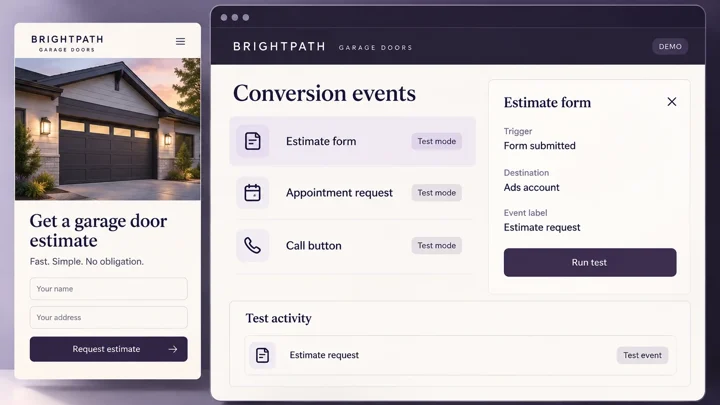
Next, test the contact path rather than assuming it works. Tap the phone number on a mobile device. Submit the estimate form using ordinary information. Check required fields, validation, the success message and the destination that receives the request. Confirm that calls and forms are measured as separate actions and that test submissions do not disappear into an unmonitored inbox.
Common conversion leaks
- The phone action is difficult to find or not tappable.
- The page does not confirm the service area.
- The visitor cannot tell whether the company handles the specific job.
- Stock imagery replaces real proof without clear labeling.
- The form asks for more information than the first conversation requires.
- The page offers several competing next steps without a clear primary action.
- The mobile layout is slow, crowded or difficult to use.
- The form appears to submit but gives no understandable confirmation.
Evaluate conversion with the company’s own qualified traffic and inquiry data. A universal conversion-rate promise cannot account for trade, market, emergency intent, seasonality, reputation, price or how the business answers the phone.
4. Are inquiries being caught and followed up?
A website may be creating opportunities even when the owner experiences no leads. Calls can go unanswered, form notifications can reach the wrong inbox, text replies can sit unmonitored and after-hours requests can receive no next step.
Trace one test inquiry through the full workflow. Who receives it? How is it assigned? What happens when the primary person is in the field? Is there an acknowledgment? Who monitors replies? What happens when the customer does not answer the return call?
Automation can acknowledge a request or help route information, but it does not remove human ownership. A missed-call text should not claim that a technician is dispatched when no one has reviewed the request. A form confirmation should explain what happens next using a response expectation the team can actually meet.
Measure the complete handoff
- Qualified calls received
- Calls answered and missed
- Forms and messages received
- Time and ownership of the first response
- Estimate or appointment requests created
- Booked work, tracked separately from raw leads
This separates a marketing problem from an operational leak. Sending more inquiries into a weak follow-up process can raise spending without raising booked work.
How SEO and AI-search visibility fit together
AI-search visibility is not a separate shortcut around search fundamentals. Google’s official AI features guidance says that the same foundational SEO practices remain relevant for AI Overviews and AI Mode. To be eligible as a supporting link, a page must be indexed and eligible to appear in normal search with a snippet. Google does not require special AI schema or a separate machine-readable file for inclusion.
For a home-service company, practical AI-search preparation therefore starts with clear, corroborated business information:
- Accurate services, locations and contact details
- Pages that directly answer buyer questions
- Real project evidence and permissioned reviews
- Helpful internal links that show how topics relate
- Structured data that matches visible page information
- Consistent information across the website and Business Profile
Do not evaluate AIO only by whether a tool reports an AI score. Ask which pages are indexed, which questions they answer, whether the business is mentioned accurately and what qualified actions follow from that visibility. No agency can guarantee that a particular AI system will cite or recommend a business.
A practical 30/60/90-day signal guide
This is a diagnostic sequence, not a ranking or lead guarantee. Timing varies by the site’s history, competition, market and the work completed.
First 30 days: verify the foundation
- Confirm priority pages can be crawled and indexed.
- Submit the sitemap and inspect important URLs.
- Test calls, forms, analytics and conversion events.
- Correct Business Profile and website inconsistencies.
- Record baseline queries, impressions, clicks and qualified inquiries.
By 60 days: look for directional evidence
- Are priority pages earning relevant impressions?
- Are new commercial queries appearing?
- Are the intended service pages receiving the visits?
- Are ads and organic search sending people to matching destinations?
- Are inquiries reaching the correct person?
By 90 days: evaluate the weakest stage
- Visibility without clicks suggests a relevance, position or search-result problem.
- Qualified clicks without inquiries suggest a trust or conversion problem.
- Inquiries without booked work suggest a fit, response or sales-process problem.
- No meaningful visibility suggests that the content, technical foundation or authority plan needs revision.
Changes can surface on different timelines. Do not wait indefinitely for a lagging indicator; use the evidence available at each stage to decide the next improvement.
What to fix first: a symptom-based checklist
If the site has almost no impressions
- Check indexing and crawl access.
- Strengthen service and location relevance.
- Improve internal linking.
- Review Business Profile information, reviews and local authority.
If the site has impressions but few clicks
- Review the queries and current ranking positions.
- Clarify page titles and descriptions.
- Make the offer more specific to the search.
- Confirm that the page answers the intended location and service.
If the site has qualified visits but no calls
- Test the first mobile screen.
- Make the primary contact action obvious.
- Bring real proof closer to the decision.
- Test every phone and form action.
- Remove unnecessary form friction.
If inquiries arrive but jobs do not
- Audit missed calls and reply ownership.
- Review lead quality by source.
- Track estimates and booked jobs separately.
- Set a realistic acknowledgment and follow-up process.
Make the diagnosis before buying more traffic
The best next move depends on where the evidence stops. A company with almost no relevant impressions may need stronger local SEO and service content. A company that needs opportunities immediately may consider properly tracked Google Ads or eligible Local Services Ads while organic visibility develops. A company already receiving qualified visits may get more value from website and follow-up improvements than from another traffic campaign.
Start with the stage that is clearly weakest. Then measure whether that change moves the next signal: indexed pages to impressions, impressions to qualified clicks, qualified visits to conversations, and conversations to booked work.
Brandiket’s free Growth Audit is designed to help identify a practical starting point across the website, visibility and inquiry path. It does not promise rankings or booked jobs; it helps determine what should be examined next.
Sources and further reading
Common buyer question
How long should it take a home-service website to start generating calls?+
There is no universal timeline. A newly launched or substantially changed site may need time to be crawled, indexed and evaluated. Review leading signals in sequence: indexation, relevant impressions, qualified clicks, inquiries and booked work. If the earlier signals are not improving, diagnose the foundation rather than simply waiting.
Can a website rank well and still generate no calls?+
Yes. It may rank for informational or poorly matched searches, attract customers outside the service area, lack visible proof, hide the contact action or lose inquiries during follow-up. Review queries, landing pages, contact actions and response handling separately.
Should I run Google Ads while SEO is developing?+
Paid search can create immediate visibility when the campaign, location targeting, landing page and conversion tracking are properly configured. It does not repair a weak page or follow-up process, so verify those foundations before increasing spend.
Is AIO or AI-search optimization different from SEO?+
AI-search visibility has additional reporting and content considerations, but it still depends heavily on normal search fundamentals. Google states that pages must be indexed and eligible for normal search snippets to appear as supporting links in its AI features, and no special AI schema is required.
What should I check first if my contractor website gets traffic but no leads?+
Confirm that the traffic comes from relevant commercial searches. Then test the mobile call action and form, verify the service and coverage area are immediately clear, bring real proof close to the contact action, and trace a test inquiry through the complete follow-up process.
Our home-service approach is informed by founder Shane Harriott’s field-service experience. Read the Brandiket story.
YOUR NEXT STEP
Find the first leak before buying more traffic.
Review your website, search visibility and inquiry path to identify the most practical place to start.
Get My Free Growth Audit