In this guide
Originally published September 6, 2026. Prices and package references reflect that article’s publication. See current Brandiket pricing for today’s offers.
If you've been looking into paid advertising for your local business, you've probably come across both Google Ads and Local Services Ads. They both put your business at the top of search results. They're both managed through Google. But they work differently, cost differently, and make sense for different situations.
This guide breaks down exactly how each option works, what the real differences are, and how to think about which one — or whether a combination of both — makes sense for your business.
What Are Google Search Ads?
Google Search Ads (often called Google Ads or PPC — pay-per-click) are paid text ads that appear at the top and bottom of Google search results pages. When someone searches for something like "HVAC repair near me" or "personal injury attorney Fort Lauderdale," advertisers in that market can have their ads appear at the top of those results.
You choose which keywords trigger your ads, write the ad copy, set your budget, and only pay when someone actually clicks on your ad. How much you pay per click depends on the competitiveness of the keyword, your quality score, and your bid.
Clicks send visitors to a page on your website — usually a landing page or service page — where they can learn more and contact you. This means your website plays a significant role in whether those paid clicks actually turn into leads.
How Google Ads are priced
You pay per click, not per lead. Costs vary significantly by industry and location — from a few dollars per click in low-competition markets to $30–$100+ per click in fields like personal injury law or home services in competitive cities.What Are Local Services Ads?
Local Services Ads (LSA) are a separate Google advertising product designed specifically for service-based local businesses. They appear above regular Google Ads — at the very top of the search results page — as a set of business cards showing the company name, rating, and a phone number or message option.
The key differences from Google Ads: you pay per lead (a verified call or message), not per click. Businesses with LSA also display a Google Guaranteed or Google Screened badge, which requires passing a background check and verification process through Google.
LSA don't direct people to your website. Instead, they go to a Google-hosted business profile. The customer contacts you directly through that interface.
Who qualifies for LSA?
LSA are available for specific categories — plumbers, electricians, HVAC, locksmiths, cleaners, lawyers, financial planners, and other service categories. Not every business type qualifies. The list of eligible categories changes and varies by market.Google Ads vs Local Services Ads: Key Differences
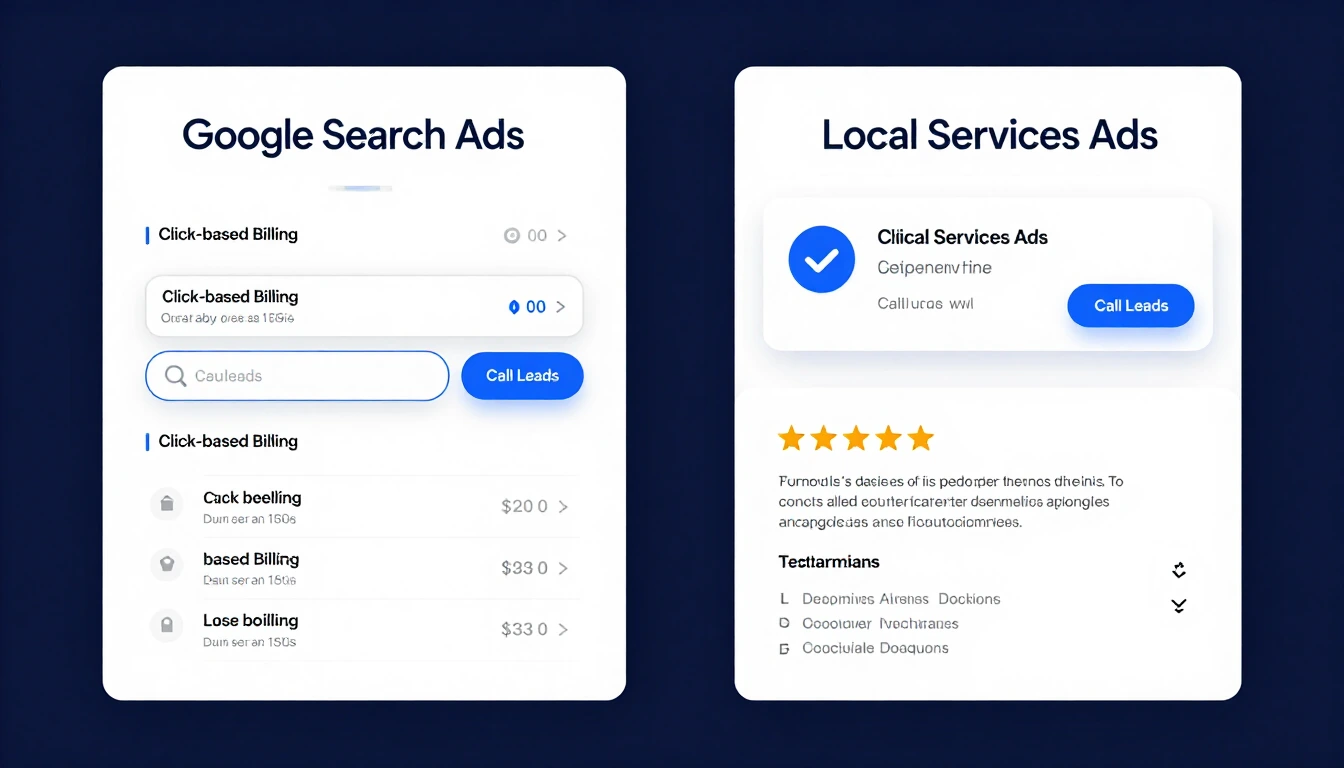
Google Ads vs Local Services Ads — Side by Side
| Factor | Google Search Ads | Local Services Ads |
|---|---|---|
| Placement | Below LSA and shopping ads, above organic results | Very top of results page, above all other ads |
| Billing model | Pay per click (CPC) | Pay per lead (verified calls/messages) |
| Keyword control | Full control over keywords and match types | Limited — Google assigns relevant categories |
| Landing pages | Directs to your website or landing page | Google-hosted profile — no landing page |
| Business eligibility | Available to virtually any business | Limited to specific service categories |
| Google Guaranteed | No | Yes — background check required |
| Geographic targeting | Precise — city, radius, zip code | Service area — less granular |
| Optimization | Extensive — bids, copy, audiences, extensions | Limited — primarily category and budget |
| Tracking | Full conversion tracking, analytics integration | Basic lead tracking within LSA dashboard |
When Google Ads Makes More Sense
Google Ads gives you significantly more control and flexibility. It's typically the better choice when:
- Your business isn't eligible for LSA. Many business types either aren't available in LSA or aren't in categories Google has opened up yet.
- You want to drive traffic to specific pages. Google Ads clicks land on your website, which means you can direct people to service-specific pages, promotions, or landing pages designed to convert.
- You need granular targeting. Google Ads lets you target specific zip codes, radius around a location, specific devices, times of day, and more.
- You want to advertise multiple services. You can run different campaigns for different services, each with its own messaging, landing page, and budget.
- You need detailed tracking and reporting. Full Google Analytics integration, conversion tracking, and advanced reporting are available.
- You have a website built for conversion. If your website is strong — fast, mobile-friendly, with clear CTAs — Google Ads can make excellent use of it.
When Local Services Ads May Make More Sense
LSA has genuine advantages in specific situations:
- You want to pay for leads, not clicks. If you're in a market where Google Ads costs per click are high and your conversion rate is uncertain, the pay-per-lead model of LSA can offer more predictable cost-per-acquisition.
- Your website isn't ready yet. Because LSA don't require a landing page, they can generate calls even if your website isn't optimized for conversion.
- You want to build reviews and trust on Google quickly. The Google Guaranteed badge and prominent placement can help establish trust, particularly for newer businesses.
- You're in an eligible, high-competition service category. For certain categories — particularly emergency services like plumbing, HVAC, and electrical — LSA's top placement can be valuable.
A word of caution on LSA lead quality
Not all LSA leads are high-quality. Some businesses find that a portion of billed LSA leads are spam or wrong-number calls. Google does allow disputes for invalid leads, but it requires active management of your account.Can You Use Both?
Yes — and for eligible businesses, running both simultaneously is a reasonable strategy. The two products occupy different positions on the same search results page, which means combined they can increase your overall visibility.
A typical approach for an eligible local service business might be:
- LSA for direct call generation from high-intent searches
- Google Ads for traffic to specific service pages and for targeting searches LSA doesn't cover
The practical constraint is budget. Running two paid channels simultaneously costs more, and for smaller budgets it may make more sense to concentrate spend on one platform and do it well rather than spreading it thin across both.
What About SEO?
Google Ads and LSA both provide paid visibility. That visibility stops the moment you stop paying. Local SEO works differently — it builds organic search presence over time that doesn't disappear when a campaign budget runs out.
For most local businesses, paid advertising and local SEO serve different roles. Paid search provides immediate visibility and consistent lead volume. Local SEO builds long-term authority that reduces your dependence on ad spend over time.
They're complementary, not competing. Businesses that invest in both tend to see better overall results than those that rely exclusively on one channel.
How Much Should a Local Business Spend?
There's no universal answer. What a reasonable Google Ads budget looks like depends on your industry, market, competition, geographic area, and goals. A plumber in a small market competing against a few local businesses has very different economics than a personal injury attorney in a major metro.
Some factors that drive Google Ads costs up:
- Highly competitive industries (legal, home services, healthcare)
- Large metro markets where more advertisers compete for the same keywords
- High-value service categories where competitors bid aggressively
- Emergency services where search volume is high and intent is strong
A realistic starting range for most local service businesses investing in Google Ads — including management fees — tends to be $1,000–$2,500 per month combined (management plus ad spend). Some industries and markets require more to compete meaningfully.
If you're unsure what a reasonable budget looks like for your specific market, a free Growth Audit is a practical starting point.
Which Should You Choose?
Here's a practical framework based on business type:
- HVAC, plumbing, electrical, cleaning (eligible for LSA): Consider starting with LSA to establish reviews and call volume, then adding Google Ads once your website and conversion paths are ready.
- Roofing, general contractors: Google Ads typically provides better targeting and flexibility. LSA availability varies by market.
- Legal (personal injury, family law): Google Ads offers more control. LSA may be available as "Google Screened" for attorneys in some markets.
- Healthcare and professional services: Generally better served by Google Ads given the need for specific service page targeting and more complex messaging.
- Businesses without a strong website: LSA is lower-friction to start since it doesn't require a landing page. Building a proper website should follow quickly.
For most local businesses, the most important factor isn't which channel to choose — it's whether the campaign is set up well and managed actively. Poorly structured campaigns on either platform waste money.
Final Thoughts
Google Ads and Local Services Ads both have genuine value. The right choice depends on your industry eligibility, your website, your budget, and your goals. For many eligible local businesses, the answer eventually becomes both — but starting with one well-managed campaign is usually better than spreading a limited budget too thin.
Brandiket manages Google Ads and lead generation campaigns for local businesses. If you'd like a clear picture of what paid advertising could look like for your specific market and business type, a free Growth Audit is a good place to start.
YOUR NEXT STEP
Need Help with Google Advertising?
Brandiket manages Google Ads and Local Services Ads campaigns for local businesses. Clear scope, pricing and agreement options.
Explore Lead Generation